
How Building Foundations Are Designed: Which Soil Requires Which Type of Foundation?
Every strong building starts with something you rarely see but absolutely rely on: the foundation. A foundation is more than just concrete poured into the ground. It’s a carefully engineered structural system designed to safely carry the entire weight of a building and transfer it to the soil beneath.
And here’s the critical part — not every soil can carry every type of structure, and not every structure uses the same type of foundation.
So how do engineers decide what kind of foundation a building needs? Let’s dive into how foundations are built, how soil affects design choices, and why the right foundation can literally save a building from disaster.

Why Foundations Exist in the First Place
A building foundation has three essential missions:
Support the weight of the structure
Distribute loads evenly into the ground
Prevent settlement, tilting, cracking, or collapse
If this step goes wrong, everything above it goes wrong too.
That’s why foundation engineering starts long before concrete is poured. It begins with soil investigation.
Step One: Understanding the Ground – Soil Investigation
Before designing a foundation, engineers must learn what’s going on beneath the surface. This is done through geotechnical surveys and soil boring tests.
During testing, engineers examine:
Soil type (sand, clay, silt, rock, etc.)
Moisture levels
Bearing capacity (how much load it can carry)
Risk of swelling, shrinking, or liquefaction
Groundwater level
Risk of earthquakes
Because remember one golden rule in construction:
The building doesn’t rest on the foundation.
The foundation rests on the soil.
And if the soil is weak, everything is weak.

Not All Soils Are Equal
Here’s a simple way to understand different soil behaviors.
🟢 Strong Soils
Rock
Dense sand and gravel
Compacted soil
These soils can carry heavy loads with minimal settlement.
🟡 Medium Soils
Slightly loose sand
Mixed soils
Firm clay
These can carry buildings but need careful design.
🔴 Weak or Problematic Soils
Soft clay
Wet silt
Peat
Expansive clay
Areas with high groundwater
These soils can:
Sink
Expand or shrink
Lose strength during earthquakes
Cause uneven settlement
Here is where foundation engineering becomes critical.
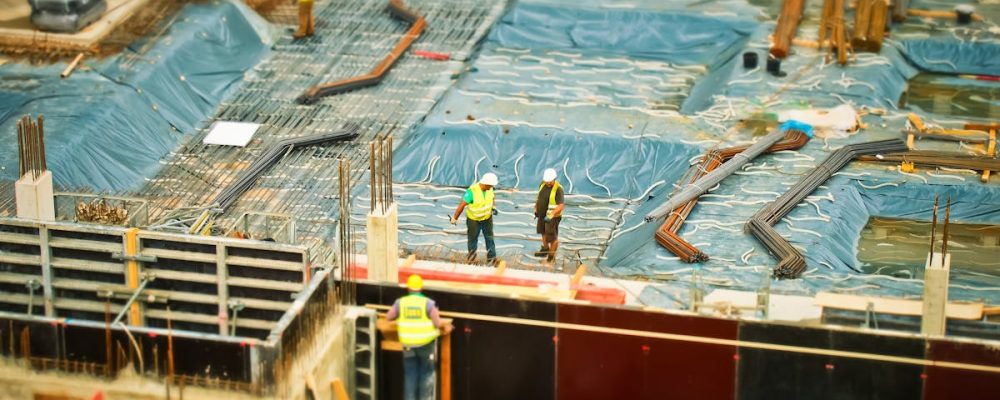
Types of Foundations: Which Soil Needs Which One?
Foundations are usually divided into two main categories:
1️⃣ Shallow Foundations
2️⃣ Deep Foundations
Which one is used depends entirely on the soil and building loads.
🟢 Shallow Foundations (For Strong and Stable Ground)
Shallow foundations are used when the soil near the surface is strong enough to carry loads.
1️⃣ Spread Footing Foundation
This is the most common foundation type for houses and low-rise buildings.
Concrete pads under columns or walls
Spreads the load over a wider area
Works best on strong or moderately strong soils
2️⃣ Raft (Mat) Foundation
Used when soil is not too weak but not great either, or the building load is spread widely.
A single large reinforced concrete slab under the entire building
Distributes load evenly
Reduces risk of differential settlement
Common in medium-rise buildings, hospitals, and factories

🔵 Deep Foundations (For Weak or Risky Soil)
When the surface soil cannot safely carry the building, engineers send the foundation deeper, until it reaches strong soil or bedrock.
1️⃣ Pile Foundations
Long columns driven deep into the ground.
They can be:
Steel piles
Reinforced concrete piles
Timber piles (for certain environments)
Used when:
Soil near surface is weak
Building loads are heavy
High-rise buildings
Coastal or swampy lands
They transfer loads to deeper, stronger layers.
2️⃣ Caisson / Drilled Shafts
These are massive concrete shafts drilled into the ground.
Used for:
Bridges
Skyscrapers
Heavy industrial structures
They anchor deep and provide huge stability.

Groundwater & Earthquake Considerations
If groundwater is high:
Extra waterproofing
Special foundation design
Drainage systems required
If the region is earthquake-prone:
Flexible foundation systems
Liquefaction risk analysis
Base isolation in advanced systems
Because in earthquakes, weak soil can behave like liquid.
A well-designed foundation prevents catastrophic tilting or collapse.
What Happens If the Wrong Foundation Is Used?
Simple answer: disasters.
Possible consequences:
Cracked walls and floors
Doors and windows misaligned
Uneven settlement
Tilting buildings
Full structural failure
Every collapsed building has one story in common: something went wrong in design or soil understanding.
Real-World Examples
🏢 Skyscrapers use piles or caissons because loads are massive.
🏠 Regular homes use spread or raft foundations if soil is decent.
🌉 Bridges always require deep foundations since loads are extreme.
Every building type needs the right foundation brainwork behind it.

Conclusion
A foundation may look like just concrete underground, but it’s actually one of the most carefully engineered parts of any structure.
Choosing the right foundation isn’t guesswork — it’s the result of soil science, structural engineering, safety calculations, and experience.
Right soil + right foundation = safe, stable, long-lasting buildings.
Wrong soil + wrong foundation = cracks, tilting, danger, and sometimes tragedy.
So next time you see a building under construction, remember:
The most important part is the part you never see.